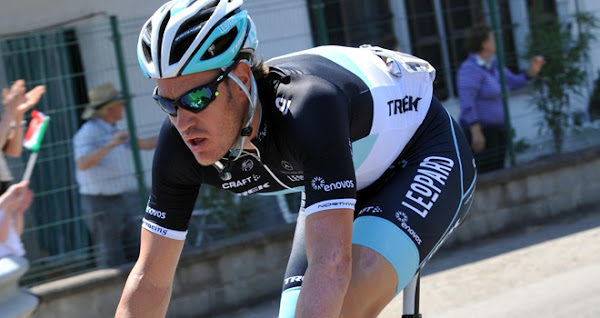


At last Garmin Cervelo rider Tyler Farrar has got a TdF stage win under his belt. A good sprint by him and his team. It was quite moving to see him saluting his friend Wouter Weylandt who we lost at the Giro Click for image and story
Tyler and Wouter were best friends and Tyler was absolutely devastated by his loss.
For me though, the stage was spoiled by the reaction of the Commissars to what they must have thought was outrageously dangerous riding. Disqualifying Mark Cavendish and Thor Hushovd from the intermediate sprint results. Yes there was a bit of contact but hey, that is what sprinters do. It looked like Thor wanted to get onto the wheel of the rider ahead of Cav, which is a legitimate tactic. Cav wasn't going to let him, which is also a legitimate tactic. Thor tried to ease Cav out of the way, Cav leaned into Thor a bit to stop him. Both are experienced and skilled sprinters so, no risk, no danger, no problem- unless you are a Commissar.
The Commissars are the 'referees' of the race, keeping an eye on wht is going on, ruling on any disputes and dealing with any breaches of the rules. This time they got it wrong, horribly wrong. If sprinters are going to be penalised every time there is a bit of contact in the race, things are going to get very pedestrian and boring.
Thor lost 4 points in this but Cav, who was first across the line in the peleton (but 6th across the line in total because of the breakaway), lost 10 points. Thor apparently offered to take the punishment alone but Cav was still disqualified. A nice gesture by Thor.
Tuesday, 5 July 2011


Sunday, 3 July 2011
The Tour continues
Well done to Team Garmin Cervelo winning todays Team Time Trial and getting Thor Hushovd into the Yellow Jersey and David Millar into second on the same time. A very good ride. In fact, there were a few good rides today, BMC surprising many by getting second spot and putting Cadel Evans into third in the GC, just 4 seconds off the pace. Team Sky had a good run at it also, finishing third and getting Geraint Thomas up to 4th in the GC, also 4 seconds off the pace. If Sky play their cards right over the next few days, Geraint could find himslef in Yellow, the first Welshman to do so. Give it some G!
Mark Cavendish and the boys had a good ride, finishing in 5th place. They were hindered today though as they lost Bernard Eisel from the train very early. It looked like he and another HTC team member may have touched wheels in a tight left bend which took Bernard down. The course being so short, they rest of the boys couldn't really afford to wait for him so they had one less person to take their turn on the front. Chin up guys. Early days.
Mark Cavendish and the boys had a good ride, finishing in 5th place. They were hindered today though as they lost Bernard Eisel from the train very early. It looked like he and another HTC team member may have touched wheels in a tight left bend which took Bernard down. The course being so short, they rest of the boys couldn't really afford to wait for him so they had one less person to take their turn on the front. Chin up guys. Early days.
And they're off!
So the Tour is under way.
A good stage today to get the ball rolling (or at least I thought so). Good result for Phillipe Gilbert, he's having a stonking year! Not so good for Alberto, what with being on the wrong side of that big crash with about 10k to go. Over a minute and a half down I think.
I bet that spectator that collected the Astana rider to set crash in action has got a sore shoulder.
It looks like the organisers have changed the rules for the points competition. Instead of 2 or three intermediate sprints earning the firs three riders 3, 2 and 1 points, this year there is just one intemediate sprint per stage with 20 points on offer to the first rider and the next 14 riders also earn points. The stage finishes have different points totals as well-
On Flat stages, first place takes 45 points, then 35, 30, 26, 22, 20, 18, 16, 14, 12, 10, 8, 6, 4, and 2.
On Medium Mountains stages, first place takes 30 points, then 25, 22, 19, 17, 15, 13, 11, 9, 7, 6, 5, 4, 3, 2 and 1.
On High Mountain stages, first place takes 20, then 17, 15, 13, 11, 10, 9, 8, 7, 6, 5, 4, 3, 2 and 1.
For Time Trial stages, first place takes 20, then 17, 15, 13, 11, 10, 9, 8, 7, 6, 5, 4, 3, 2 and 1.
This seems, on first glance, to favour the sprinters like Mark Cavendish. It may result in some tactical changes however. We will have to see.
More on tactics when I do the next Laymans (or Laywomans) guide.
A good stage today to get the ball rolling (or at least I thought so). Good result for Phillipe Gilbert, he's having a stonking year! Not so good for Alberto, what with being on the wrong side of that big crash with about 10k to go. Over a minute and a half down I think.
I bet that spectator that collected the Astana rider to set crash in action has got a sore shoulder.
It looks like the organisers have changed the rules for the points competition. Instead of 2 or three intermediate sprints earning the firs three riders 3, 2 and 1 points, this year there is just one intemediate sprint per stage with 20 points on offer to the first rider and the next 14 riders also earn points. The stage finishes have different points totals as well-
On Flat stages, first place takes 45 points, then 35, 30, 26, 22, 20, 18, 16, 14, 12, 10, 8, 6, 4, and 2.
On Medium Mountains stages, first place takes 30 points, then 25, 22, 19, 17, 15, 13, 11, 9, 7, 6, 5, 4, 3, 2 and 1.
On High Mountain stages, first place takes 20, then 17, 15, 13, 11, 10, 9, 8, 7, 6, 5, 4, 3, 2 and 1.
For Time Trial stages, first place takes 20, then 17, 15, 13, 11, 10, 9, 8, 7, 6, 5, 4, 3, 2 and 1.
This seems, on first glance, to favour the sprinters like Mark Cavendish. It may result in some tactical changes however. We will have to see.
More on tactics when I do the next Laymans (or Laywomans) guide.
Friday, 1 July 2011
Allez Allez!
This evening sees the commencement of my annual three weeks of staying up late to watch the highlights of the days Tour de France stage.
The race actually starts tomorrow but, British Eurosport being the Damn Good Eggs that they are, are showing a Mark Cavendish special plus two previews, one about the main contenders for the race and the other being the official introduction of the teams.
Seeing as how Cav is the Official Pro Cyclist of The Secret Cyclist blog (not that he knows, but I know), it would be very remiss of me not to watch him wouldn’t it? The other two programmes are proper fan fodder and I will watch them cos it is cycling on the tellybox, which is A Good Thing.
A Layman’s (or Laywoman’s) guide to the Tour de France (TdF) Part 1
The TdF starts on the first Saturday in July each year and finishes on the Sunday, 3 weeks later. This entails 21 days racing with 2 rest days. This year, the rest days are between stages 9 and 10 and stages 15 and 16.
Most years, the first day is a prologue, a short Time Trial stage of 5 to 10 kilometres. This year however, stage 1 is a full on mass start stage of 191.5 kilometres.
There are 4 types of stage in the Tour. Time Trail (TT) stages, ‘flat stages’, medium mountain stages and high mountain stages.
For TT stages each rider sets off individually at timed intervals. Stage lengths are between 20 to 50 kilometres roughly and it is literally a race against the clock. There is another TT type, called the Team Time Trial (TTT) where each team sets off together and rides as fast as it can over the course. The Teams time is taken as the 5th rider crosses the line. If all 9 members of the team finish together, they get the time of the 5th rider. If the team splits, the first 5 riders get the time of the 5th rider. The remaining riders get their own actual time.
 Team Lampre's TT bikes at Monaco the day before the prologue for the TdF 2009
 Cav on the prologue in Monaco for the TdF 2009

Flat stages are pretty much just that, flat of lightly rolling roads with no climbs of note. These tend to be targeted by sprinters for stage wins.
 A team Liquigas Cannondale being prepared for Stage 1 of the 2009 TdF (Mrs Secret Cyclist in the background)
Medium mountain stages involve more strenuous climbing but not the really hard mountains.
High mountains are just that, lung busting, leg killing mountain passes and summit finishes.
There are 5 separate competitions within the race as follows-
The General Classification (GC). The leader in the GC is the leader of the race overall. He is identified by the fabled Yellow Jersey (Maillot Jaune). This is the rider with the smallest aggregate time for the race at the start of each stage. Contenders for the ultimate prize need to be very good all round riders. In recent years, contenders have been strong climbers with good time trialling ability.
The Points Competition, often called the Sprinters competition. The leader in this competition is identified as he wears the Green Jersey (Maillot Vert). Each road stage includes one or two intermediate sprints. Points are awarded in descending order to the first three riders across the line- 6, 4 then 2 points. The same happens at the end of stages also but, a stage winner can gain up to 35 points on a flat stage, with the first 25 riders earning points down to 1 point. On Medium Mountain stages it is the first 20 riders with the points range between 25 and 1. On High Mountain stages the first 15 riders earn between 15 and 1 point. TT stages also have points, ranging between 15 and 1 for the first 10 riders.
The winner of the point’s competition is the rider with most points who finishes the Tour
King of the Mountains (KoM) who is identified by the Polka Dot jersey (Maillot a pois rouges). This is a white jersey with red polka dots. This competition is another point’s competition, where the points are earned by being in the first number of riders to cross the line on climbs. The climbs in the TdF fall into 5 different categories, depending on their length, gradient and where they occur in a stage.
The easiest climbs are 4th category climbs with 3, 2 and 1 points being awarded to the first 3 across the line.
Next is 3rd cat climbs with between 4 and 1 points awarded to the first 4 riders.
2nd cat climbs have the first 6 riders earning between 10 and 5 points.
1st cat climbs earn the first 8 riders between 15 and 5 points.
That leaves climbs that are beyond classification or Hors Categorie (HC). These are the steepest, longest and hardest climbs in the Tour. The first 10 riders on HC climbs earn between 20 and 5 points.
The winner of the KoM completion is the rider with most climbing points who finishes the Tour.
Best Young Rider who is identified by the White Jersey (Maillot Blanc). This competition is amongst all riders under 26 years of age as of 1st January that year. The leader in the competition is the qualifying rider highest up the GC competition.
The Team Competition is similar to the GC but is worked out using the time of the best three riders of each team, each day. The team leading this competition is identified by the numbers on their jerseys being black numbers on a yellow background as opposed to the standard black on white.
It is common for the same rider to lead several competitions. In the event this is the case, he wears the jersey of the higher competition so, a rider leading the points and GC competition would wear the yellow jersey. The rider second in the lower competition then wears the competition jersey. As a result, not every rider you see wearing a competition jersey is actually the leader (apart from the GC jersey).
Not a competition but, seen by many fans of the race as a badge of honour, is the Lantern Rouge or red Lantern. This is the rider last in the overall classification- the rider who has taken the longest time so far. In early years, the Lantern Rouge was just that, a small red light on the back of that rider’s bike. I think (though am not certain at the moment) that the Lantern Rouge wears red numbers on a white background.
More later.
The race actually starts tomorrow but, British Eurosport being the Damn Good Eggs that they are, are showing a Mark Cavendish special plus two previews, one about the main contenders for the race and the other being the official introduction of the teams.
Seeing as how Cav is the Official Pro Cyclist of The Secret Cyclist blog (not that he knows, but I know), it would be very remiss of me not to watch him wouldn’t it? The other two programmes are proper fan fodder and I will watch them cos it is cycling on the tellybox, which is A Good Thing.
A Layman’s (or Laywoman’s) guide to the Tour de France (TdF) Part 1
The TdF starts on the first Saturday in July each year and finishes on the Sunday, 3 weeks later. This entails 21 days racing with 2 rest days. This year, the rest days are between stages 9 and 10 and stages 15 and 16.
Most years, the first day is a prologue, a short Time Trial stage of 5 to 10 kilometres. This year however, stage 1 is a full on mass start stage of 191.5 kilometres.
There are 4 types of stage in the Tour. Time Trail (TT) stages, ‘flat stages’, medium mountain stages and high mountain stages.
For TT stages each rider sets off individually at timed intervals. Stage lengths are between 20 to 50 kilometres roughly and it is literally a race against the clock. There is another TT type, called the Team Time Trial (TTT) where each team sets off together and rides as fast as it can over the course. The Teams time is taken as the 5th rider crosses the line. If all 9 members of the team finish together, they get the time of the 5th rider. If the team splits, the first 5 riders get the time of the 5th rider. The remaining riders get their own actual time.
 Team Lampre's TT bikes at Monaco the day before the prologue for the TdF 2009
 Cav on the prologue in Monaco for the TdF 2009
Flat stages are pretty much just that, flat of lightly rolling roads with no climbs of note. These tend to be targeted by sprinters for stage wins.
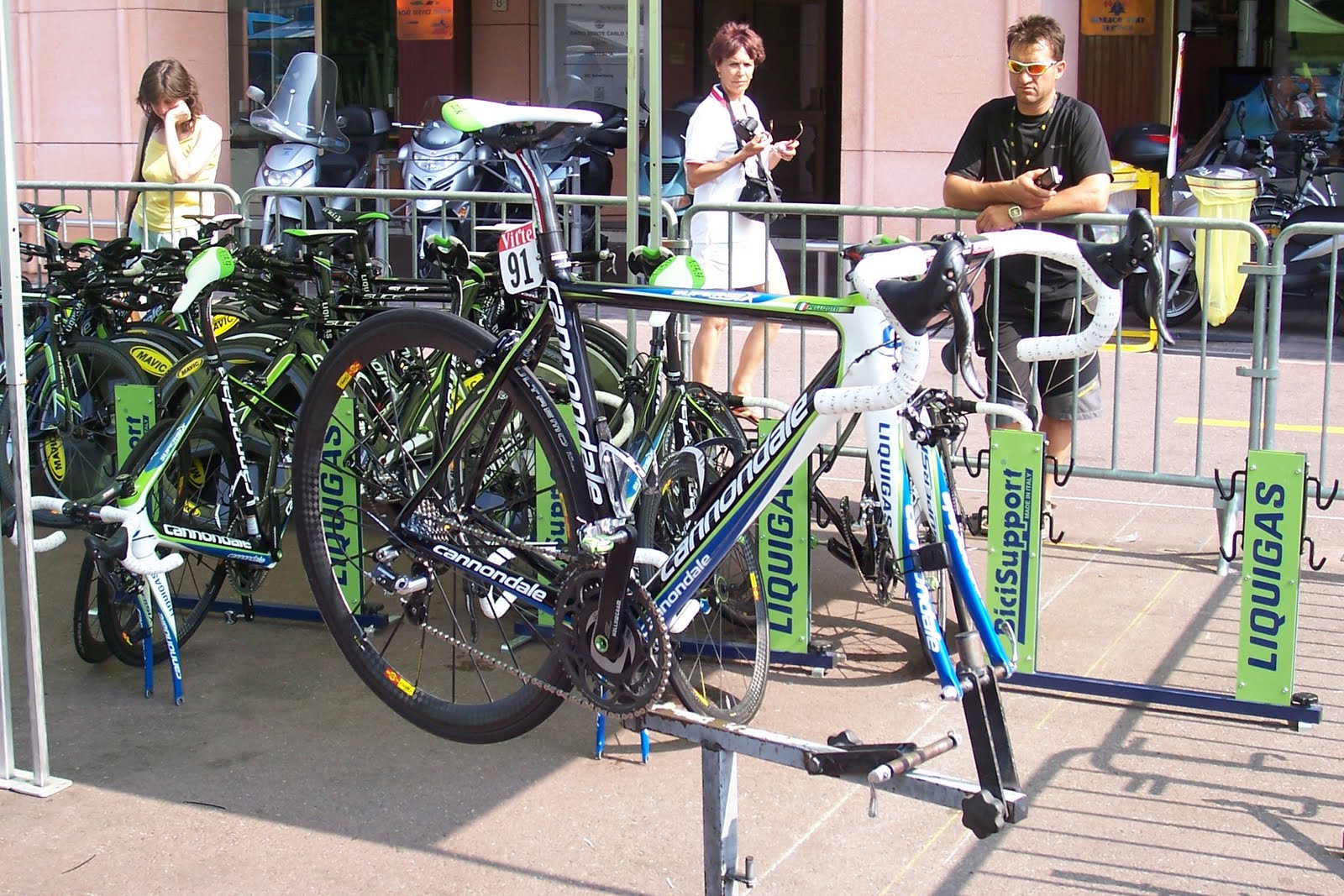 A team Liquigas Cannondale being prepared for Stage 1 of the 2009 TdF (Mrs Secret Cyclist in the background)
Medium mountain stages involve more strenuous climbing but not the really hard mountains.
High mountains are just that, lung busting, leg killing mountain passes and summit finishes.
There are 5 separate competitions within the race as follows-
The General Classification (GC). The leader in the GC is the leader of the race overall. He is identified by the fabled Yellow Jersey (Maillot Jaune). This is the rider with the smallest aggregate time for the race at the start of each stage. Contenders for the ultimate prize need to be very good all round riders. In recent years, contenders have been strong climbers with good time trialling ability.
The Points Competition, often called the Sprinters competition. The leader in this competition is identified as he wears the Green Jersey (Maillot Vert). Each road stage includes one or two intermediate sprints. Points are awarded in descending order to the first three riders across the line- 6, 4 then 2 points. The same happens at the end of stages also but, a stage winner can gain up to 35 points on a flat stage, with the first 25 riders earning points down to 1 point. On Medium Mountain stages it is the first 20 riders with the points range between 25 and 1. On High Mountain stages the first 15 riders earn between 15 and 1 point. TT stages also have points, ranging between 15 and 1 for the first 10 riders.
The winner of the point’s competition is the rider with most points who finishes the Tour
King of the Mountains (KoM) who is identified by the Polka Dot jersey (Maillot a pois rouges). This is a white jersey with red polka dots. This competition is another point’s competition, where the points are earned by being in the first number of riders to cross the line on climbs. The climbs in the TdF fall into 5 different categories, depending on their length, gradient and where they occur in a stage.
The easiest climbs are 4th category climbs with 3, 2 and 1 points being awarded to the first 3 across the line.
Next is 3rd cat climbs with between 4 and 1 points awarded to the first 4 riders.
2nd cat climbs have the first 6 riders earning between 10 and 5 points.
1st cat climbs earn the first 8 riders between 15 and 5 points.
That leaves climbs that are beyond classification or Hors Categorie (HC). These are the steepest, longest and hardest climbs in the Tour. The first 10 riders on HC climbs earn between 20 and 5 points.
The winner of the KoM completion is the rider with most climbing points who finishes the Tour.
Best Young Rider who is identified by the White Jersey (Maillot Blanc). This competition is amongst all riders under 26 years of age as of 1st January that year. The leader in the competition is the qualifying rider highest up the GC competition.
The Team Competition is similar to the GC but is worked out using the time of the best three riders of each team, each day. The team leading this competition is identified by the numbers on their jerseys being black numbers on a yellow background as opposed to the standard black on white.
It is common for the same rider to lead several competitions. In the event this is the case, he wears the jersey of the higher competition so, a rider leading the points and GC competition would wear the yellow jersey. The rider second in the lower competition then wears the competition jersey. As a result, not every rider you see wearing a competition jersey is actually the leader (apart from the GC jersey).
Not a competition but, seen by many fans of the race as a badge of honour, is the Lantern Rouge or red Lantern. This is the rider last in the overall classification- the rider who has taken the longest time so far. In early years, the Lantern Rouge was just that, a small red light on the back of that rider’s bike. I think (though am not certain at the moment) that the Lantern Rouge wears red numbers on a white background.
More later.
Thursday, 30 June 2011
The countdown begins
Tomorrow night is the start of three weeks of late nights as I sit up after Mrs Secret Cyclist has gone to bed, watching the days recording of the Tour de France highlights.
The tour kicks off on Saturday but tomorrow, Eurosport is showing a Mark Cavandish special which, seeing as Cav is the Official Pro Cyclist of the Secret Cyclist blog (not that he knows, but I know), it would be wrong of me not to watch, followed by two previews, one about the General Classification contenders and another being the official introduction of the teams.
Get in there!
A brief idiots guide to the Tour de France-
It starts on the first Saturday in July and finsihes on the Sunday 3 weeks later.
The first day is usually (though not always) a prologue, a short time trial (TT) stage of around 5 to 10 kilometers.
There are 6 competitions within the race-
General Classification or GC. This rider wears the fabled Maliot Jaune or yellow jersey. It is worn by the rider who has clocked up the shortest combined time for the race as it progresses. A GC contender needs to be a good all round rider but recently,good climbers with TT ability have faired well.
The points competition (often refered to as the sprinters competition). The leader in thei competiton wears the green jersey. Points are awarded in most road stages at intermediate sprints (usually 2 per stage) where the first few riders accross the line get points in descending order. There are also points (a larger total) won at the end of a stage, which is why the likes of Cav or Thor Hushovd are seen in the jersey a lot. Sprint stage winners can gain 35 points per stage.
The King of the Mountain (KoM) who wears the polka dot jersey (white with red polka dots). This is similar in style to the points jersey but the points are won by being first to cross the line on classified climbs. There are 5 classes of climb from Cat 4 being the easiets categorised climb, getting harder (steeper and/ or longer) through Cats 3,2 and 1 and then onto Hors Categorie (HC) of out of category. These climbs are those that are so long and sustained that getting up them sometiems leaves quality climbers shattered.
The tour kicks off on Saturday but tomorrow, Eurosport is showing a Mark Cavandish special which, seeing as Cav is the Official Pro Cyclist of the Secret Cyclist blog (not that he knows, but I know), it would be wrong of me not to watch, followed by two previews, one about the General Classification contenders and another being the official introduction of the teams.
Get in there!
A brief idiots guide to the Tour de France-
It starts on the first Saturday in July and finsihes on the Sunday 3 weeks later.
The first day is usually (though not always) a prologue, a short time trial (TT) stage of around 5 to 10 kilometers.
There are 6 competitions within the race-
General Classification or GC. This rider wears the fabled Maliot Jaune or yellow jersey. It is worn by the rider who has clocked up the shortest combined time for the race as it progresses. A GC contender needs to be a good all round rider but recently,good climbers with TT ability have faired well.
The points competition (often refered to as the sprinters competition). The leader in thei competiton wears the green jersey. Points are awarded in most road stages at intermediate sprints (usually 2 per stage) where the first few riders accross the line get points in descending order. There are also points (a larger total) won at the end of a stage, which is why the likes of Cav or Thor Hushovd are seen in the jersey a lot. Sprint stage winners can gain 35 points per stage.
The King of the Mountain (KoM) who wears the polka dot jersey (white with red polka dots). This is similar in style to the points jersey but the points are won by being first to cross the line on classified climbs. There are 5 classes of climb from Cat 4 being the easiets categorised climb, getting harder (steeper and/ or longer) through Cats 3,2 and 1 and then onto Hors Categorie (HC) of out of category. These climbs are those that are so long and sustained that getting up them sometiems leaves quality climbers shattered.
Wednesday, 29 June 2011
I found someones map!
On my ride home after work this evening I happened across a couple partaking of a cycle touring holiday. They were riding in the opposite direction and needed directions to Maidenhead. As I helped them, I thought I detected a Dutch accent (Yes Tommy, a Dutch accent. The time spent with you has rubbed off and added to my accent identification skills!).
I pointed them in the right direction and left them to continue their journey. About 5 minutes up the road however I spied a map laying in the middle of the road. I stopped and checked it out and found it to be a tourist map of the Thames Valley. I guessed that one of the couple I had met a few minutes ago had lost it so tucked it into my jersey pocket, turned round and gave chase.
I followed the route I had given them but got to the main junction with no sign of them. I had looked along a couple of side roads as I passed without seeing them either. Not happy I decided to turn round and try the main side road but got a considerable way along it without finding the couple. I thought al was lost and turned round again to make my way home but, as I rode back towards my route home I saw the couple riding towards me. I stopped and handed their map over.
It turned out that they had seen a small cycle path sign saying Maidenhead was 2 miles along a cycle path. They had tried to follow but, British cycle facilities being what they are, they found that they couldn't get their luggage laiden Dutch Bikes through the narrow barriers just along from the start of the route. They had turned round and decided to follow the road.
We chatted for a little while and I learned that they started the day in Oxford and had cycled along paths along the banks of the Thames, planning to ride to London but, on reaching Marlow they decided that the route was too rough so decided to head for Maidenhead and get the train into London. I was right about their accent, they were from the Netherlands, living near to Arnhem. I explained that I had a friend who was a Bike Cop in Den Haag (The Hague) and the guy said he was born in Den Haag and their son lived in Scheveningen. I know someone who lives in Scheveningen don't I Tommy?
I said goodbye to them and finished my ride home. An extra 22 minutes and an extra 5 1/2 miles on the commute. All miles are good miles.
I pointed them in the right direction and left them to continue their journey. About 5 minutes up the road however I spied a map laying in the middle of the road. I stopped and checked it out and found it to be a tourist map of the Thames Valley. I guessed that one of the couple I had met a few minutes ago had lost it so tucked it into my jersey pocket, turned round and gave chase.
I followed the route I had given them but got to the main junction with no sign of them. I had looked along a couple of side roads as I passed without seeing them either. Not happy I decided to turn round and try the main side road but got a considerable way along it without finding the couple. I thought al was lost and turned round again to make my way home but, as I rode back towards my route home I saw the couple riding towards me. I stopped and handed their map over.
It turned out that they had seen a small cycle path sign saying Maidenhead was 2 miles along a cycle path. They had tried to follow but, British cycle facilities being what they are, they found that they couldn't get their luggage laiden Dutch Bikes through the narrow barriers just along from the start of the route. They had turned round and decided to follow the road.
We chatted for a little while and I learned that they started the day in Oxford and had cycled along paths along the banks of the Thames, planning to ride to London but, on reaching Marlow they decided that the route was too rough so decided to head for Maidenhead and get the train into London. I was right about their accent, they were from the Netherlands, living near to Arnhem. I explained that I had a friend who was a Bike Cop in Den Haag (The Hague) and the guy said he was born in Den Haag and their son lived in Scheveningen. I know someone who lives in Scheveningen don't I Tommy?
I said goodbye to them and finished my ride home. An extra 22 minutes and an extra 5 1/2 miles on the commute. All miles are good miles.
Tuesday, 28 June 2011
Awesome light this morning
As I went to bed last night, I was wondering where the thunder storms that the weather bods had suggested were coming had got to.
Their absence led to a hot sticky night but, on waking up at stupid o'clock this morning, the sky had clouded over and the temperature had dropped quite markedly.
Whilst I was in the kitchen preparing my (and No.1 Sons) lunch and feeding the cats, there were a couple of flashes of lightning, followed a second or two later by rolling thunder (for Vietnam Veterans I mean the noisy natural weather phenomenon, not the noisy B52 induced phenomenon). I expected to get very wet on the ride in.
Once the lunches had been done, tea drunk and Shredded Wheat consumed, I got dressed and went out to the bike. The sky was still dark but no rain was falling so I decided to risk no waterproof jacket as that would have been far too hot. Within 5 minutes of setting out the sun started to make a concerted effort to break through. The light was amazing. I can only describe it as glowing silver, a sort of mean and moody black and white film atmosphere. Something to behold.
I bet the drivers didn't even register it.
I arrived at work without getting rained on, though the last half mile or so were on damp roads. There was a lot of very wet cycling kit hanging in the changing room.
I love riding my bike.
Their absence led to a hot sticky night but, on waking up at stupid o'clock this morning, the sky had clouded over and the temperature had dropped quite markedly.
Whilst I was in the kitchen preparing my (and No.1 Sons) lunch and feeding the cats, there were a couple of flashes of lightning, followed a second or two later by rolling thunder (for Vietnam Veterans I mean the noisy natural weather phenomenon, not the noisy B52 induced phenomenon). I expected to get very wet on the ride in.
Once the lunches had been done, tea drunk and Shredded Wheat consumed, I got dressed and went out to the bike. The sky was still dark but no rain was falling so I decided to risk no waterproof jacket as that would have been far too hot. Within 5 minutes of setting out the sun started to make a concerted effort to break through. The light was amazing. I can only describe it as glowing silver, a sort of mean and moody black and white film atmosphere. Something to behold.
I bet the drivers didn't even register it.
I arrived at work without getting rained on, though the last half mile or so were on damp roads. There was a lot of very wet cycling kit hanging in the changing room.
I love riding my bike.
Subscribe to:
Posts (Atom)